|
Please join us on Facebook at "Rhode Island Catholic Medical Society."
http://www.facebook.com/home.php?#!/group.php?gid=57417346446&ref=ts
|
An "FYI" .. . .
Dignitas Personae (The Dignity of the Person), an Instruction on ethical issues arising from biomedical research, was published by the Congregation for the Doctrine of the Faith, 12 December 2008.
The Instruction defends the life of unborn human beings, created in the image of God, and provides guidance on how to respect human life and human procreation in our scientific age.
You may download it by going to www.ewtn.com. Once that pages opens, you will see a "hotlink" bearing the document's name. Just click onto it.
|
************************************************************************************************************************
The Catholic Medical Society of Rhode Island was formally approved by Bishop Thomas J. Tobin on April 26, 2007. For further information, please contact the association President, Dr. Dan Harrop, at danharrop@hotmail.com.
We maintain a mailing list (email and postal addresses) of Catholic physicians in RI (which is NOT used as a referral service but only to communicate to members about special events) and to be added, please send you email to CathMedRI@yahoo.com, or mail to Dr. Harrop, Box 603364, Providence, RI 02906.
Full (voting) membership is contingent upon membership in the Catholic Medical Association, and membership can be obtained at http://www.cathmed.org, but ALL physicians, practitioners and patients are invited to our open, public events.
********************************************
THE CATHOLIC PHYSICIAN
Being a Catholic medical doctor is a ministry, which springs from a vocation within the Church. It is the mission of healing. It is strongly linked to God our Father and expresses Christ the Physician, full of Love, which is the Holy Spirit. To be a medical doctor is a path by which to reach and achieve the fullness of the human being. It involves a special nearness to, and intimacy with God; and it also means an openness and total giving to other people. This, then, is the Catholic identity of the medical doctor to be the transmittance of the healing Christ.
Our MissionAs Catholic Physicians of the United States and Canada, we come together in the Catholic Medical Association in order to grow in the spirit of Christ in our personal and professional lives, to bring His Spirit to all that is touched by our science and art, and to assist the Vicar of Christ, the Bishops, and the whole Christian community with leadership, especially with the particular knowledge, skill, and experience we have as Christian Physicians.
Who Should Join the Catholic Medical Association?
- Physicians and Dentists: Active, Retired and Residents
- Nurses
- Medical Students
- Allied Health Care Professionals
- Clergy, Religious and Seminarians
- All people interested in supporting the promotion of Catholic values in Medicine
Member Benefits are Spiritual, Professional, Educational and Social
Spiritual and Professional Support: Receive support in maintaining Catholic values while pursuing your medical career. Help students and residents prepare for an exciting and challenging future in medicine. Terrific networking opportunities.Issues: Learn about Catholic values in Medicine on pertinent issues such as physician assisted suicide, abortion, Natural Family Planning and access reference material on the Catholic position on health-related issues. Publications: Receive the The Linacre Quarterly, an outstanding journal published by the CMA focusing on ethical, medical and moral issues. You will also receive our National Newsletter with latest CMA news, current events and activities. Conferences: Attend regional and national conferences designed to increase awareness of moral issues faced by physicians and health care professionals. CME credits are usually offered at these events. Local Activities: There may be a Local Guild already established in your area or diocese. Local Guild activities include networking and support opportunities, annual St. Luke's Mass, seminars, and civic and private volunteer programs. International Service: Volunteer for service in health care projects overseas through our Medical Missions program.
Promise of the Catholic Doctor
I, solemnly promise:
- To continually improve my professional abilities, in order to give my patients the best care I can.
- To respect my patients as human persons, putting their interests ahead of political and economic considerations, and to treat them without prejudice arising from religion, racial, ethnic, socio-economic or sexual differences.
- To defend and protect human life from conception to its natural end, believing that human life, transmitted by parents, is created by God and has an eternal destiny that belongs to Him.
- To refuse to become an instrument of violent or oppressive applications of medicine.
- To serve the public health, promoting healthful policies respectful of life and the dignity and nature of the human person.
- To cooperate with the applications of just law, except on the grounds of conscientious objection when the civil law does not respect human rights, especially the right to life.
- To work with openness toward every person, independently of their religious beliefs.
- To donate part of my time for free and charitable care of the poor.
In order to achieve these goals, as a Catholic Doctor I also promise:
- To recognize the Word of God as the inspiration of all my actions, to be faithful to the teachings of the Church and to form my professional conscience in accord with them.
- To cultivate a filial relationship with God, nourished by prayer, and to be a faithful witness of Christ.
- To practice Catholic moral principles, in particular those related to bio-medical ethics.
- To express the benevolence of Christ in my life, and in my relationships with patients, colleagues and society.
- To participate in the evangelization of the suffering world, in cooperation with the pastoral ministry of the Church.
PRAYER OF THE CATHOLIC PHYSICIAN
Lord Jesus,Divine Physician, who in your earthly life showed special concern for those who suffer and entrusted to your disciples the ministry of healing, make us ever ready to alleviate the trials of our brethren. Make each one of us, aware of the great mission that is entrusted to him, strive always to be, in the performance of daily service, an instrument of your merciful love. Enlighten our minds, guide our hands, make our hearts diligent and compassionate. Ensure that in every patient we know how to discern the features of your divine Face.
You who are the Way, provide us with the gift of knowing how to imitate you every day as medical doctors not only of the body but of the whole person, helping those who are sick to tread with trust their own earthly path until the moment of their encounter with You.
You who are the Truth, provide us with the gift of wisdom and science in order to penetrate the mystery of the human person and their transcendent destiny as we draw near to them in order to discover the causes of their maladies and find suitable remedies.
You who are the Life, provide us with the gift of preaching and bearing witness to the 'Gospel of life' in our profession, committing ourselves to defending it always, from conception to its natural end, and to respect the dignity of every human being, and especially the dignity of the weakest and the most in need.
Make us O Lord, Good Samaritans, ready to welcome, treat, and console those we encounter in our work. Following the example of the holy medical doctors who have preceded us, help us to offer our generous contribution to the constant renewal of health care structures.
Bless our studies and our profession, enlighten our research and our teaching. Lastly, grant to us, having constantly loved and served You in our suffering brethren, that at the end of our earthly pilgrimage we may contemplate your glorious countenance and experience the joy of the encounter with You in your Kingdom of joy and everlasting peace.
Amen.
The Vatican, 29 June 2000
John Paul II
|
Bishop Celebrates White Mass for Medical Professionals
By Emily Donohue, Staff Reporter, The RI Catholic
PROVIDENCE – The Church of Our Lady of the Rosary was filled with doctors, nurses and others who work in medical fields last Tuesday, October 16, 2007, as Bishop Thomas J. Tobin celebrated the diocesan White Mass.
Bishop Tobin expounded on the differences between a job and a vocation in his homily.
“I hope that you always see your work not as a simple job that you have to do, not even just as a profession in which you take true pride, but I hope you see your work as a true vocation for which God has created you,” he said.
Catholic healthcare, Bishop Tobin said, is a phrase that encompasses so much about everyone who attended the Mass. “Healthcare is what you do, Catholic is what you are,” he said.
Catholics working in the healthcare field are doing important work for the Church, he told the congregation. “Jesus cured every kind of ailment and disease, Jesus touched people and he sought their physical, their mental and their spiritual healing. Almost invariably, when Jesus cured someone physically, he was most of all concerned with their spiritual well-being,” he said. “Those of you who are involved in Catholic healthcare continue the work of Jesus, the work of the Church,” Bishop Tobin added.
The White Mass, which may become an annual event like the Red Mass for legal professionals, was an outgrowth of the recently created Rhode Island Catholic Medical Society. The Society, which was officially created earlier this year, serves to connect Catholic healthcare professionals in the state and holds events such as medical and theological lectures, dinners, and a Catholic Hippocratic oath ceremony for recent graduates of medical school.
Dr. Tom Vest, a retired OB-GYN, who attended the Mass said his faith was very important to his work. “I could not practice obstetrics and gynecology without having it,” he said.
Joan Dobrzynski, a nurse, agreed, “I think your faith is who you are, and no matter what you do, it affects your decisions,” she said.
|
The Brief History of the CMA
By Lynne Bissonnette-Pitre, MD, PhD
The first Catholic Physicians Guild was founded in 1912 in Boston by William Cardinal O’Connell in order to educate physicians in Church doctrine related to the practice of medicine. In 1927 R. A. Rendick, M.D. began a guild in Brooklyn, New York by convening physicians and a chaplain for a retreat using the spiritual exercises of St Ignatius. The purpose of the retreat was to strengthen their Catholic spirituality and to encourage growth in holiness. In the next year the idea of the Catholic Physicians Guild spread throughout the boroughs of New York City and to other cities of eastern United States as many physicians began to gather with a chaplain for spiritual formation.
By 1932 the dream of a national organization of Catholic physicians came to fruition. With the leadership of Dr. Rendrick the National Federation of Catholic Physicians Guilds (NFCPG) began in New York City as a unification of the existing seven guilds. The objectives of the NFCPG were to foster the Catholic physicians’ faith and relationship with God and His Church, the physicians’ knowledge and practice of moral and ethical medical principles and the solidarity among its members. To achieve these objectives the NFCPG formed a Board of Directors who hosted an annual meeting, organized North America into ten regions and appointed regional directors who were given the task of forming local guilds throughout the country.
The purpose of the local guild was to provide spiritual counsel and moral guidance to the local physician members so that the physicians would become more earnestly aware of their dependence upon God, truly Catholic in their practice of medicine and Christ-like in their works of mercy. The locus of each guild was a moderator or chaplain who functioned as the spiritual father and director for his flock of physicians. The guilds met for Mass, spiritual retreats, Recollection, and bioethical seminars. The October 18th Feast of St. Luke, the patron saint of physicians, was the high point of the guilds’ yearly activities. White Masses were celebrated for Saint Luke in hospitals, chapels, parish churches and Cathedrals and everywhere that the physicians routinely gathered with their chaplains.
Simultaneous with the foundation of the NFCPG the Linacre Quarterly was begun. As a journal of the philosophy and ethics of medical practice its purpose was to inform the subscribers of Catholic principles applied to the pertinent medical and scientific issues of the times. The name Linacre Quarterly was chosen to honor Thomas Linacre M.D. who had been a physician and priest in 16th century England and had served as the private physician of Henry VIII. Dr. Linacre founded the Royal College of Physicians and through it regulated the practice of medicine in England. He was well known for his scholarship and high ideals of scientific medicine and Catholicism.
Initially the responsibility for the Linacre Quarterly was shared by the member guilds with each guild taking its turn at submitting all the articles for one issue to a designated local editor. This created a Brooklyn issue, a Boston issue, a Philadelphia issue; etc. After 1944 the circulation of the Linacre Quarterly continued to grow and reached a high point of 10,300 in 1965. The first Linacre award was given in 1957 on the occasion of the Silver Anniversary of the NFCPG to Rev. J.J. Flanagan, S.J., editor of the Linacre Quarterly for his outstanding scholarship, journalism and contribution to the journal.
In 1948 there were eleven member guilds in the NFCPG. In 1950 the meeting in Atlantic City was attended by 13 guilds. In 1957 there were 60 guilds; and in 1960 there were 92 member guilds in the USA, Canada and Puerto-Rico with a total membership of 6,110. The 100th guild, Rochester, Minnesota was welcomed in 1961 at a grand celebration in New York City. In 1963 the Federation was the sixth largest medical organization in the country with the membership of 7,000. The high mark was a total physician membership of over 10,000 in 1967.
Guilds varied in size from 6 to 600 members. The largest guild was in Boston; the smallest was in Monroe, Louisiana. Some guilds formed around physicians practicing at a specific hospital; other guilds were composed of physicians in a city, a diocese or a state. In 1961 there was one guild for the physicians of the State of Arkansas, eight for Louisiana and for the most highly organized State of New York, there were twelve guilds. The member guilds of the NFCPG were officially known as Constituent Guilds. Physicians in a Constituent Guild were known as Constituent Members of the NFCPG. If a physician lived in an area not served by a guild, he was eligible to join as an Individual Member. If a physician belonged to a guild that was not a Constituent Guild, he was eligible to join as an Associate Individual Member.
The constituent guild members paid dues directly to the NFCPG and the local guild received back from the Treasurer an amount equal to the local guild dues. In 1950 the NFCPG dues were $1.00 per year. In 1956 the dues were raised to $5.00 and in 1965 the dues were set at $25.00.
The Constitution and By-laws of the NFCPG created a representational organization governed by a Directorship. The Board of Directors was composed of the executive committee (the officers of the Board), Regional Directors, Episcopal Advisor (a Bishop) and the Moderator (chaplain). The United States, Puerto Rico and Canada formed ten regions with each region represented by two Regional Directors. The tasks of creating guilds, of organizing local and regional meetings and of acting as the liaison between the NFCPG board of directors and the local guilds were given to the Regional Directors.
Each Constituent Guild elected a delegate for a one-year term. The guild delegate represented the guild at the annual national meeting with the right of one vote in all matters before the General Assembly and in the election of officers and Regional Directors.
The Constituent Guilds of each region nominated candidates for the office of Regional Director. The Regional Directors were elected at the annual meeting by the officers and guild delegates and served a term of two years on the Board of Directors. If there were not enough Constituent Guilds in a region to nominate candidates, the Board of Directors made the nominations. The Board of Directors had the power to appoint two Regional Directors to fill vacancies.
Any group of six or more Catholic physicians in the same general area could accept the NFCPG Charter and make a request to become a Constituent Guild of the NFCPG. The Regional Director forwarded to the executive director the guild application with recommendations for each physician stating that he was in good standing in his medical practice and in his parish. The executive secretary then submitted the guild application, the Regional Director’s recommendation and all other pertinent information to the Board for action at the annual meeting.
Upon its inception in 1932, the NFCPG met once each year at the American Medical Association meeting. The reason to meet at the AMA meeting was convenience as the vast majority of physicians in the early decades of the 20th century attended the AMA meeting. The AMA functioned in much the same way that specialty medical associations function today. For one week medical scientific papers were presented for physicians to become current on research and practice. On the Friday of the AMA meeting, the NFCPG conference opened with an officers meeting and Holy Mass celebrated especially for any deceased members of the NFCPG. At the general meeting following Mass each guild delegate gave a report of his guild’s activities of the proceeding year. A dinner for the physicians and spouses was held on Friday evening.
The first year that the NFCPG met at a separate time and place from the AMA was 1956 when the Detroit Guild under president Paul Muske M.D. hosted the 1956 meeting in Detroit. Another first for the 1956 annual meeting was a conference with speakers on current medical moral issues added to the regular program and evening banquet with a guest speaker. The following year 1957 the annual meeting was held in New York City and the tradition of a conference on medical moral issues with an evening banquet in the city of the NFCPG president was established.
The first four presidents of the NFCPG served a four-year term. In 1948 the term was shortened to two years and in the last decades the term of officers has been one year. From 1932 until 1944 the president of the NFCPG presided over the administrative activities of dues and membership from his own local office. The records and administrative functions shifted location with each new president.
In 1944 the NFCPG set up permanent headquarters in the offices of the Catholic Hospital Association (CHA) in St Louis. This was the beginning of the twenty-one year administrative association with the Catholic Hospital Association. The executive director of the CHA served as the Moderator (chaplain) of the NFCPG, as organizer of the NFCPG annual meetings, as editor of the Linacre Quarterly (the sole Medical-Moral Journal published at that time) and maintained the financial and membership records for the NFCPG. The health care of priests and religious was a particular concern for both the NFCPG and the CHA and together they formed a program to meet these needs.
Both the CHA and the NFCPG came under the supervision of the Social Action Department of the National Council of Catholic Bishops (NCCB). The relationship between the NFCPG and the NCCB was characterized by mutual respect and cooperation for twenty years. The Bishops relied upon the physicians of the NFCPG for their expert opinions on medical issues. In addition the White House regularly asked the NFCPG to brief the administration on the Catholic perspective on current medical-ethical issues.
The twenty-fifth anniversary of the foundation of the NFCPG was celebrated on June 5th, 1957 at the Waldorf-Astoria in New York City. Cardinal Spellman, Archbishop of New York City welcomed the physicians and blessed them on the occasion of their Silver Jubilee. Pope Pius XII sent a letter of congratulations, affirmation, encouragement and an apostolic blessing. [See appendix for the letter of Pope Pius XII]. The Honorary Committee for the Silver Jubilee included His Eminence Cardinal Spellman, His Excellency Richard Cushing, Archbishop of Boston, Averall Harriman, the governor of New York State and Robert Wagner, the mayor of New York City.
In 1961 the NFCPG returned to New York City on the 28th of June to celebrate the affiliation of the 100th guild, the Guild of Rochester Minnesota. Cardinal Spellman again welcomed the physicians with his blessings and prayers [See appendix for Cardinal Spellman’s prayer, the certificate of the 100th Guild and the roll call for 1961].
In 1965 the relationship with the CHA fractured when the CHA endorsed socialized medicine and the NFCPG opposed it. The executive committee of the NFCPG made the decision to dissociate from the CHA. Robert Herzog was hired to serve as the executive secretary of the NFCPG and administrative headquarters were moved to Milwaukee, Wisconsin.
A strain in the relationship with the National Catholic Conference of Bishops began in 1964 over contraception. In 1964 the NFCPG co-sponsored with the Family Life committee of the NCCB a conference in Washington DC on Natural Family Planning. Over 200 Family Life Diocesan Directors attended. During the conference a sub-group of attendees drafted a letter to be sent to Pope Paul VI asking him to endorse the use of the contraceptive pill. After a debate in the general assembly, a substitute resolution was adopted to develop a special commission composed of an equal number of Catholic physicians and family life diocesan directors to study human life, NFP and abortion. The Commission met four times a year in Chicago for years. The physician component strongly supported Humanae Vitae while many of the Family Life Directors openly supported contraception.
In the years subsequent to the promulgation of Humanae Vitae, the NFCPG was torn apart in its interior with successive presidents elected from opposite sides of the contraception controversy. At the NFCPG national meeting in Miami, Florida in 1968 the majority vote of the general assembly supported the Holy Father and Humane Vitae. This so inflamed the president of the NFCPG that he resigned and many guilds separated from the NFCPG. Eventually the strong guilds from Detroit, St. Louis, Milwaukee, New York and Boston as well as a multitude of smaller guilds became virtually inactive. The membership of the NFCPG dropped to a low point of 300 physicians and two Member Guilds: Chicago and Philadelphia. Throughout the next three decades the NFCPG although significantly reduced in size continued its yearly annual meeting and remained vital by the hard work of the physicians loyal to the Catholic Church and to her magisterial teaching.
The international organization of Catholic physicians known as the Federation of International Catholic Medical Associations (FIAMC) also known as the World Catholic Medical Association met in New York City in 1998 in a conjoint program with the CMA. George Isajiw M.D. of the Philadelphia Guild and a Board member of FIAMC served as the program chairman and organized a superb meeting in collaboration with Rick Watson M.D. the president of the CMA. St. Patrick’s Cathedral in New York City and Cardinal O’Connor hosted Mass for the physicians.
In 1997 the Board of Directors changed the name from National Federation of Catholic Physicians Guilds to the Catholic Medical Association (CMA) to reflect that the membership consisted almost entirely of Individual Members. Chicago and Philadelphia continued as the only Member Guilds and they did not elect delegates to the general assembly. The Regional Directors of the ten regions were appointed by the Executive Committee and served primarily the national organization rather than the region. In fact by 2000 most Regional Directors had no idea what their job description had been at the foundation of the organization. Existing throughout the United States and Canada were a few Catholic Physicians Guilds unaffiliated with the CMA and most often unknown to the Regional Directors. Many of these guilds had no members belonging to the CMA while others had a few members in the CMA.
As the new millennium dawned the CMA Board of Directors recognized the problem of being too centrally focused and the failure to serve physicians at the local level. The Regional Directors were once again encouraged to function in accordance with the original Constitution and By-laws with the primary focus on the creation of local Guilds. Consequently many of the independent Guilds have once again become Member Guilds and many new guilds have been formed. The President of FIAMC, Dr. Gigli attended the CMA Executive Directors Retreat in January 2003 to encourage and to affirm the importance of fostering the local physicians guilds.
With the springtime of the new Millennium, the revitalization of the Church and of the Catholic Physicians has begun. Once again Catholic Physicians are seeking to learn of the high ideal of God’s call (vocation) to become physicians to the practice of medicine in conformity to Christ the Divine Physician. The CMA is challenged to be the voice of truth for all physicians and for the community; to keep biotechnology in conformity with the Laws of God; to promulgate the Catholic concepts of person, rights and the common good as applied to the practice of medicine; to defend the sacredness and dignity of life at all stages; and to teach the Catholic norm of morality rooted in its source and authority of the natural law, divine positive law and the ecclesial Magisterium. This is the orthopraxis or ‘right action’ of the Catholic physician.
Tradition teaches that orthopraxis cannot be separated from orthodoxy. While the current concept of orthodoxy is ‘right doctrine’, the Fathers of the Church understood orthodoxy to mean the authentic adoration and glorification of the Lord, the right relationship with God. To be in right relationship with God (orthodoxy) would naturally result in the right action to please God (orthopraxis) [Cardinal Joseph Ratzinger, The Greatest Mystery, Inside the Vatican, Aug-Sept 2002, p.12]. The founding doctors of the CMA (NFCPG) understood this principle and initiated the formation of physicians through spiritual retreats and spiritual counsel.
The CMA strives to serve, to form and to teach its apostolate of Catholic physicians as it did in the beginning through Member Guilds formed in conformity to the CMA. It is the intention of the CMA to have local Catholic Physicians Guilds in every state, diocese and parish in North America in order to carry forth the mission of forming the identity of the Catholic Physician as Icon of Christ the Divine Physician.
|
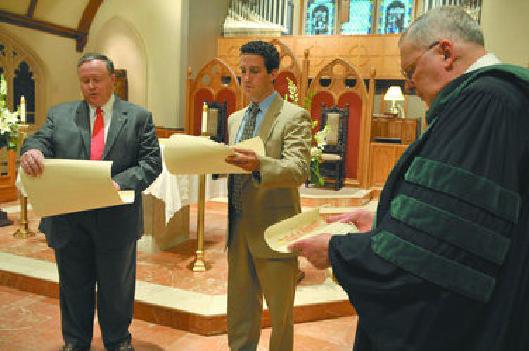 |
| Second Annual Hippocratic Oath Ceremony |
|
|
Above, Dr. Daniel S. Harrop, left, and Dr. Jason DeGregorio, center, take the Hippocratic oath at a June 1 ceremony at St. Sebastian Church. They promised to maintain respect for life at all stages during the practice of medicine and in their lives.
|
Doctors pledge to uphold sanctity of life
BY EMILY DONOHUE, Staff Reporter
PROVIDENCE – Two doctors, both graduates of Brown University's medical school, stood in front of their friends, families and colleagues at St. Sebastian Church June 1 to take the Hippocratic Oath and vow as well to uphold the sanctity of life at all stages in their practice of medicine and throughout their lives.
Dr. Daniel S. Harrop, president Rhode Island guild of the Catholic Medical Association, and Dr. Jason DeGregorio, a 2002 graduate, took the oath during a Mass organized by the Catholic Medical Association.
The oath they took differs greatly from the one that most medical schools, including Brown, administer to their graduating students. Both doctors pledged to "maintain the utmost respect for every human life, from fertility to natural death." They also made specific pledges against practicing abortion or administering lethal doses of medication.
DeGregorio felt that taking the oath publicly was important, even though he is not currently practicing medicine.
"Even though I'm not necessarily practicing medicine I try to always be up front with people about my stand on these things," he said. He took the oath privately after his graduation from Brown, but jumped at the opportunity to participate in the public ceremony.
Father Timothy D. Reilly is the guild's chaplain and celebrated the Hippocratic Oath Mass. In his homily he spoke of the public pressures that medical professionals face and encouraged the two men to follow God's plan.
"Every day those of you who go into battle against the culture of death can either bring blessing or bring a curse," he said. They face the opportunity "to do a great good or to compromise and to bring something less than God's plan to that situation."
|
Doctors, nurses, clergy gather for second annual White Mass
BY EMILY DONOHUE, Staff Reporter, "RI Catholic"
WARWICK – Doctors, nurses and other healthcare professionals gathered at St. Timothy Church last week to celebrate the second-annual White Mass. Organized by the Rhode Island Catholic Medical Association, the Mass was celebrated by Bishop Thomas J. Tobin as well Bishop Francis X. Roque, Bishop Emeritus for Military Services; Father Timothy Reilly, the CMA's chaplain; Father James Hamilton and Father Barry Meehan, both of St. Timothy.
Father Reilly was the homilist, delivering a sermon about the fruits, both good and bad, of their labor in the medical field.
Building on St. Paul's "laundry list" of problems that develop when there is tension between the divine and the human worlds, he said that the medical field is laden with unique and particularly troubling challenges.
"As we enter the third millennium, if we were to draft such a list tailored for those in the healthcare industry, we could even add such deformed fruits as: the sour plum of so-called “euthanasia”; the deadly apple of readily-available contraceptives and its by-product, sexual promiscuity; the bloody blight of mass “abortion on demand”; and the bitter grape of a corporate greed that has infected the American healthcare system and threatened its viability," he said.
However, by adhering closely to the teachings of the Church, Father Reilly said that those who work in healthcare have the opportunity to do truly good work, and produce "good fruit."
"In a way that priests, deacons, and even bishops cannot, you bear the ripe, luscious, and healing fruits of compassion, strength, fidelity, and love of neighbor. Your fruit is life-giving, because it grows from the healthy soil of your professional expertise and training, which in turn, is nourished through an abiding faith. And, of course, through your celebration of the faith, especially the nutrients of the holy Sacraments, you ensure that this fruit ultimately is grafted to the vine Himself, Jesus Christ."
Members of the health care field have unique and powerful opportunities to touch the lives of other people. "You daily bend down and touch our brothers and sisters when they are most vulnerable," Father Reilly said.
Father Reilly said that the purpose of the organization and the White Mass are to strengthen the resolve of healthcare professionals to stand up for Catholic teachings in the face of challenges from colleagues, patients and others. "The challenge is to navigate the secular and the faith, so by coming together hopefully we assist each other."
He added that the Rhode Island chapter of the CMA is always looking to recruit new members. "We would love to expand our scope, or even age range." Medical students and nursing students are particularly encouraged to join, he said.
He ended his homily with words of thanks and encouragement for the gathered doctors and nurses:
"I thank all of you for that good and holy work, done daily throughout this Diocese. The fruit is obvious, and it is abundant. Ever more so is the Spirit of truth which brings it to harvest. Let’s just be careful not to leave that Spirit outside our office doors."
|
|